

[Dec-2025] Download Real WGU Data-Management-Foundations Exam Dumps Test Engine Exam Questions
New Data-Management-Foundations exam dumps Use Updated WGU Exam
WGU Data-Management-Foundations Exam Syllabus Topics:
| Topic | Details |
|---|---|
| Topic 1 |
|
| Topic 2 |
|
| Topic 3 |
|
| Topic 4 |
|
NEW QUESTION # 21
What is the role of the transaction manager within the database system architecture?
- A. The transaction manager is composed of a query processor, storage manager, transaction manager, log, and catalog.
- B. The transaction manager uses information from the catalog to perform query optimization.
- C. The transaction manager translates the query processor instructions into filesystem commands and uses an index to quickly locate the requested data.
- D. The transaction manager logs insert, update, and delete queries, and the result is sent back to the application.
Answer: D
NEW QUESTION # 22
Which designation is an individual value, such as a salary?
- A. Attribute type
- B. Glossary
- C. Relationship
- D. Entity type
Answer: A
Explanation:
Anattribute typerefers to asingle, specific valuewithin a table, such as Salary, Age, or Price.
Example Usage:
A screenshot of a computer AI-generated content may be incorrect.
CREATE TABLE Employees (
EmpID INT PRIMARY KEY,
Name VARCHAR(50),
Salary DECIMAL(10,2)
);
* Salary is anattribute typewith individual values for each employee.
Why Other Options Are Incorrect:
* Option A (Glossary) (Incorrect):Refers todocumentation, not database values.
* Option B (Entity type) (Incorrect):Representsa class of objects(e.g., Employees), not individual values.
* Option D (Relationship) (Incorrect):Definesconnections between entities, not attributes.
Thus, the correct answer isAttribute type, as it represents anindividual data value.
NEW QUESTION # 23
What is the role of the database administrator?
- A. The database administrator determines the format of each data element and the overall database structure.
- B. The database administrator is a consumer of data in a database.
- C. The database administrator develops computer programs that utilize a database.
- D. The database administrator is responsible for securing the database system against unauthorized users.
Answer: D
Explanation:
ADatabase Administrator (DBA)is responsible for the management, security, and performance of a database system. This includes controlling access to data, ensuring database integrity, optimizing performance, managing backups, and protecting the system from unauthorized access.
* Option A (Incorrect):A DBA is not just a consumer of data but is primarily responsible for the database's management.
* Option B (Correct):Security is one of the key responsibilities of a DBA, including enforcing user access controls and implementing encryption and authentication mechanisms.
* Option C (Incorrect):While DBAs work with data structures, it is typically the role of adata architect ordatabase designerto define data formats and schema structures.
* Option D (Incorrect):Developing application programs that interact with the database is typically the role ofsoftware developersordatabase programmers, not DBAs.
NEW QUESTION # 24
Which function is considered an aggregate function?
- A. ABS
- B. DESC
- C. TRIM
- D. MAX
Answer: D
Explanation:
Aggregate functionsperform calculationson a set of values and return asingle result.MAX()is one such function, returning thelargest value in a column.
Common Aggregate Functions:
A screenshot of a computer AI-generated content may be incorrect.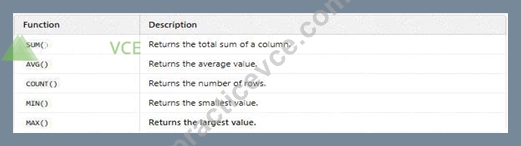
Example Usage:
sql
SELECT MAX(Salary) FROM Employees;
* Retrieves thehighest salaryin the Employees table.
Why Other Options Are Incorrect:
* Option B (TRIM) (Incorrect):Removes spaces from strings butis not an aggregate function.
* Option C (ABS) (Incorrect):Returns theabsolute value of a numberbut doesnot aggregate multiple rows.
* Option D (DESC) (Incorrect):Used in ORDER BY forsorting in descending order,not for aggregation.
Thus, the correct answer isMAX(), as it is atrue aggregate function.
NEW QUESTION # 25
Which keyword can be used as a clause in an ALTER TABLE statement?
- A. AGGREGATE
- B. DELETE
- C. CHANGE
- D. STOP
Answer: C
Explanation:
TheALTER TABLEstatement is used to modify an existing database table structure. One common clause is CHANGE, which allows renaming a column and modifying its data type.
Example:
sql
ALTER TABLE Employees CHANGE COLUMN OldName NewName VARCHAR(50);
* Option A (Incorrect):DELETE is used to removerows, not alter table structure.
* Option B (Correct):CHANGE is avalid clausefor renaming and modifying columns in MySQL and some other databases.
* Option C (Incorrect):STOP is not a valid SQL keyword for altering tables.
* Option D (Incorrect):AGGREGATE refers to functions like SUM() and AVG(), not table alterations.
NEW QUESTION # 26
Which clause or statement in a CREATE statement ensures a certain range of data?
- A. SET
- B. WHERE
- C. FROM
- D. CHECK
Answer: D
Explanation:
TheCHECKconstraint is used in SQL toenforce ruleson a column's values. It ensures that data inserted into a table meets specified conditions, such as range restrictions or logical rules.
Example Usage:
sql
CREATE TABLE Employees (
ID INT PRIMARY KEY,
Name VARCHAR(50),
Salary INT CHECK (Salary BETWEEN 30000 AND 150000)
);
* This constraint ensures thatsalary values fall between 30,000 and 150,000.
* If an INSERT or UPDATE statement tries to set Salary = 20000, itfailsbecause it does notmeet the CHECK condition.
Why Other Options Are Incorrect:
* Option B (FROM) (Incorrect):Used in SELECT statements, not for constraints.
* Option C (WHERE) (Incorrect):Filters rows in queries butdoes not enforce constraints.
* Option D (SET) (Incorrect):Used for updating records (UPDATE table_name SET column = value) butnot for defining constraints.
Thus,CHECK is the correct answer, as it ensures that column values remain within an expected range.
NEW QUESTION # 27
Which SQL command uses the correct syntax to add a new employee "John Doe" to the Employee table?
- A. INSERT INTO Employee ("John Doe");
- B. INSERT Employee { "John Doe" };
- C. INSERT Employee (Name) Values ("John Doe");
- D. INSERT INTO Employee (Name) VALUES ("John Doe");
Answer: D
Explanation:
Thecorrect syntaxfor inserting a new row into a table follows this structure:
Standard SQL INSERT Syntax:
sql
INSERT INTO TableName (Column1, Column2, ...)
VALUES (Value1, Value2, ...);
For this scenario:
sql
INSERT INTO Employee (Name) VALUES ('John Doe');
Why Other Options Are Incorrect:
* Option A (Incorrect):Uses incorrect syntax { ... }, which isnot valid SQL syntax.
* Option C (Incorrect):Does not specify the column name, whichcauses an error.
* Option D (Incorrect):Misses theINTOkeyword, which is required in standard SQL.
Thus, the correct syntax isOption B, ensuring aproperly formatted insert statement.
NEW QUESTION # 28
Which characteristic is true for non-relational databases?
- A. They support the SQL query language.
- B. They store data in tables, columns, and rows, similar to a spreadsheet.
- C. They are optimized for big data.
- D. They are ideal for databases that require an accurate record of transactions.
Answer: C
Explanation:
Non-relational databases(also calledNoSQL databases) are designed for handlingbig dataandunstructured dataefficiently. They are optimized forhorizontal scaling, making them ideal forlarge-scale distributed systems.
* Option A (Correct):Non-relational databases areoptimized for big data, handling massive volumes of data across distributed architectures.
* Option B (Incorrect):NoSQL databases donotuse SQL as their primary query language. They often use JSON-based queries (e.g., MongoDB).
* Option C (Incorrect):Transaction-heavy applications requireACID compliance, which relational databases (SQL) handle better than NoSQL databases.
* Option D (Incorrect):NoSQL databases usedocument, key-value, graph, or column-family storage models, nottables, columns, and rowslike relational databases.
NEW QUESTION # 29
Which syntax feature classifies the explicit string, numeric, or binary values used in SQL queries?
- A. Keywords
- B. Identifiers
- C. Comments
- D. Literals
Answer: D
Explanation:
In SQL,literalsrepresent explicit values such asnumbers, strings, or binary datadirectly written into queries.
For example:
SELECT * FROM Employees WHERE Salary > 50000;
Here, 50000 is anumeric literal.
* Option A (Correct):Literalsare explicit values used in SQL queries, such as 123, 'John Doe', and TRUE.
* Option B (Incorrect):Commentsare non-executable text used for documentation within SQL code, typically denoted by -- or /* ... */.
* Option C (Incorrect):Identifiersare names oftables, columns, or other database objects, such as EmployeeID.
* Option D (Incorrect):Keywordsare reserved words in SQL (e.g., SELECT, FROM, WHERE) that define operations and syntax.
NEW QUESTION # 30
How many bytes of storage does a BIGINT data type hold in MySQL?
- A. 4 bytes
- B. 8 bytes
- C. 3 bytes
- D. 1 byte
Answer: B
Explanation:
In MySQL, theBIGINTdata type is a64-bit integerthat requires8 bytes (64 bits) of storage. It is used to store large numerical values beyond the range of INT (4 bytes).
* Option A (Incorrect):1 byte corresponds toTINYINT, which can store values from -128 to 127.
* Option B (Incorrect):3 bytes is not a standard integer storage size in MySQL.
* Option C (Incorrect):4 bytes corresponds toINT, which has a range of -2,147,483,648 to
2,147,483,647.
* Option D (Correct):BIGINT takes8 bytesand supports a massive range of numbers from -2^63 to 2^63
-1.
NEW QUESTION # 31
Which keyword or clause indicates the desired sequence when displaying a set of records returned from a SELECT statement?
- A. LIKE
- B. DISTINCT
- C. BETWEEN
- D. ORDER BY
Answer: D
Explanation:
TheORDER BYclause in SQL is used tosort query resultsinascending (ASC) or descending (DESC) order
.
Example Usage:
sql
SELECT Name, Salary FROM Employees ORDER BY Salary DESC;
* This retrieves all employees, sorted bysalary in descending order.
Why Other Options Are Incorrect:
* Option A (BETWEEN) (Incorrect):Used for filtering ranges butdoes not order results.
* Option B (DISTINCT) (Incorrect):Removes duplicate rows butdoes not control order.
* Option D (LIKE) (Incorrect):Used forpattern matching, not sorting.
Thus,ORDER BY is the correct choicefor defining the sequence of query results.
NEW QUESTION # 32
Which entity in a table is a measurable object in the real world?
- A. Conceptual entity
- B. Virtual entity
- C. Tangible entity
- D. Logical entity
Answer: C
Explanation:
Atangible entityis a real-world object that can bemeasured and storedin a database.
Example Usage:
* In an inventory system,tangible entitiesinclude:
Products, Orders, Customers
Why Other Options Are Incorrect:
* Option A (Logical entity) (Incorrect):Exists logically butmay not have a physical presence(e.g., views, categories).
* Option C (Virtual entity) (Incorrect):Existsonly in queries or reports, not stored as real data.
* Option D (Conceptual entity) (Incorrect):Abstract idea used indesign modeling, not astored entity.
Thus, the correct answer isTangible entity, as it representsmeasurable, real-world objects.
NEW QUESTION # 33
Which statement uses valid syntax for the DELETE statement in SQL?
- A. DELETE * FROM table_name WHERE condition;
- B. DELETE table_name WHERE condition;
- C. DELETE FROM table_name;
- D. DELETE FROM table_name WHERE condition;
Answer: D
Explanation:
Thecorrect syntaxfor deleting records from a table in SQL is:
sql
DELETE FROM table_name WHERE condition;
This deletesonly the rowsthat match the condition.
Example Usage:
sql
DELETE FROM Employees WHERE Salary < 30000;
* Deletesall employees earning less than $30,000.
Why Other Options Are Incorrect:
* Option A (Incorrect):Missing FROMkeyword. The correct syntax is DELETE FROM table_name.
* Option C (Partially Correct):DELETE FROM table_name;deletes all rows, but it lacks a WHERE clause.
* Option D (Incorrect):DELETE *is not validin SQL. The correct command is just DELETE FROM.
Thus, the correct answer isDELETE FROM table_name WHERE condition;.
NEW QUESTION # 34
Which property is associated with a one-field primary key?
- A. Composite
- B. Numeric
- C. Duplicate
- D. Simple
Answer: D
Explanation:
Aprimary keyuniquely identifies each row in a table. When a primary key consists ofonly one field, it is called aSimple Primary Key.
Types of Primary Keys:
* Simple Primary Key (Correct Answer):
* Contains onlyone column.
* Example:
sql
CREATE TABLE Students (
StudentID INT PRIMARY KEY,
Name VARCHAR(50)
);
* Composite Primary Key:
* Usesmultiple columnsto ensure uniqueness.
* Example:
sql
CREATE TABLE Orders (
OrderID INT,
ProductID INT,
PRIMARY KEY (OrderID, ProductID)
);
* Surrogate Primary Key:
* A system-generatedunique identifier(e.g., UUID or AUTO_INCREMENT).
Why Other Options Are Incorrect:
* Option B (Duplicate) (Incorrect):A primary keymust be unique, so itcannot be duplicate.
* Option C (Numeric) (Incorrect):While primary keyscan be numeric, they can also be alphanumeric (VARCHAR).
* Option D (Composite) (Incorrect):Acompositekey consists ofmultiple fields, whereas a simple key is a single field.
Thus, the correct answer isSimple, since aone-field primary keyis a simple primary key.
NEW QUESTION # 35
Which relationship exists between occurrences of the same entity types?
- A. Cardinality
- B. Unary
- C. Binary
- D. Modality
Answer: B
Explanation:
Aunary relationship(also known as arecursive relationship) occurs when an entityrelates to itself.
Example Usage:
* Employees and Managers:
sql
CREATE TABLE Employees (
EmpID INT PRIMARY KEY,
Name VARCHAR(50),
ManagerID INT,
FOREIGN KEY (ManagerID) REFERENCES Employees(EmpID)
);
* Here, ManagerIDreferences another Employee# aunary (self-referential) relationship.
Why Other Options Are Incorrect:
* Option A (Modality) (Incorrect):Describesoptional vs. mandatoryrelationships, not self-referencing.
* Option C (Cardinality) (Incorrect):Defines how many instances relate,not the type of relationship.
* Option D (Binary) (Incorrect):Binary relationships involvetwo different entities, not self-referencing.
Thus, the correct answer isUnary, as it describesrelationships within the same entity type.
NEW QUESTION # 36
Which function measures a numeric value's distance from 0?
- A. LOWER
- B. CONCAT
- C. ABS
- D. FROM
Answer: C
Explanation:
TheABS()function in SQL returns theabsolute valueof a given number, effectively measuring itsdistance from zero.
Example Usage:
sql
SELECT ABS(-50), ABS(50);
Result:
50 | 50
* This function ensures that numbers arealways positive, regardless of their original sign.
Why Other Options Are Incorrect:
* Option A (CONCAT) (Incorrect):Used tocombine strings(not numbers).
* Option B (LOWER) (Incorrect):Converts text tolowercase, not numerical operations.
* Option C (FROM) (Incorrect):Part of SELECT FROM queries,not a function.
Thus, the correct choice isABS(), which computes the absolute value of a number.
NEW QUESTION # 37
Which SELECT statement uses valid syntax for SQL?
- A. SELECT ALL column1, column2 FROM table_name;
- B. SELECT column1, column2 FROM table_name;
- C. SELECT column1, column2 WHERE condition FROM table_name;
- D. SELECT "column name", "column name" FROM "table name" WHERE "column name"
Answer: B
Explanation:
Avalid SELECT statementin SQL follows this basic syntax:
sql
SELECT column1, column2
FROM table_name
WHERE condition;
The correct optionDfollows this syntaxcorrectly.
Why Other Options Are Incorrect:
* Option A (Incorrect):SQL does not usedouble quotes(") around column/table names unless explicitly required in some databases.
* Option B (Incorrect):The WHERE clausemust appear after the FROM clause.
* Option C (Incorrect):ALL isnota valid keyword in standard SQL queries.
Thus,Option Dfollows the correct SQL syntax.
NEW QUESTION # 38
......
Pass Your Data-Management-Foundations Dumps as PDF Updated on 2025 With 62 Questions: https://killexams.practicevce.com/WGU/Data-Management-Foundations-practice-exam-dumps.html