

Verified PDII dumps Q&As - 100% Pass from PracticeVCE
Pass PDII Exam in First Attempt Guaranteed 2026 Dumps!
NEW QUESTION # 10
A developer is tasked with ensuring that email addresses entered into the system for Contacts and for a custom object called survey Response c do not belong to a list of blocked domains.
The list of blocked domains is stored in a custom object for ease of maintenance by users. The survey Response c object is populated via a custom Visualforce page.
What is the optimal way to implement this?
- A. Implement the logic in a helper class that is called by an Apex trigger on Contact and from the custom Visualforce page controller.
- B. Implement the logic in an Apex trigger on Contact and also implement the logic within the custom Visualforce page controller.
- C. Implement the logic in validation rules on the Contact and the Burvey Response_c Objects.
- D. Implement the logic in the custom Visualforce page controller and call "that method from an Apex trigger on Contact.
Answer: A
NEW QUESTION # 11
Universal Containers (UC) has enabled the translation workbench and has translated picklist values. UC has a custom multi-select picklist field, Product__c, on the Account object that allows sales reps to specify which of UC's products an Account already has. A developer is tasked with writing an Apex method that retrieves Account records, including the Product_c field.
What should the developer do to ensure the value of Products__c is in the current user's language?
- A. Set the locale on each record in the SOQL result list.
- B. Use tolabel ducts__c) in the fields list of the SOQL query.
- C. Call the translate method on each record in the SOQL result list.
- D. Use the Locale clause in the SOQL query.
Answer: B
Explanation:
To ensure the value of Products__c is in the current user's language, the developer should use toLabel(Products__c) in the fields list of the SOQL query. The toLabel() function converts the picklist values in the query result to the user's language, if the translation workbench is enabled and the values are translated. This way, the developer can display the translated values of the custom multi-select picklist field in the Apex method. Setting the locale on each record in the SOQL result list would not work, as the locale is a user attribute, not a record attribute, and it cannot be changed by Apex code. Calling the translate method on each record in the SOQL result list would not work, as there is no such method in Apex. Using the Locale clause in the SOQL query would not work, as there is no such clause in SOQL. Reference: [Using the toLabel() Function], [Locale Class]
NEW QUESTION # 12
A developer has written the following method:
static void processList(List<sobject> input){
Which code block can be used to call the method?
- A. processList ([FIND 'Acme" 'RETURNING Account])
- B. processList (ace)
- C. processList([SELECT Id, Name FROM sObject WHERE Type = 'Account'])
- D. for Account ace : [SELECT Id, Name FROM Account])
Answer: C
NEW QUESTION # 13
A managed package uses a list of country ISO codes and country names as reference data in many different places from within the managed package Apex code.
What is the optimal way to store and retrieve the list?
- A. Store the information in a List Custom Setting and access it with the getAll() method
- B. Store the information in Custom Metadata and access it with the getAll() method
- C. Store the information in a List Custom Setting and query it with SOQL
- D. Store the information in Custom Metadata and query it with SOQL
Answer: A
Explanation:
Explanation/Reference: https://developer.salesforce.com/docs/atlas.en-us.apexcode.meta/apexcode/ apex_customsettings.htm
NEW QUESTION # 14
The following code segment is railed from a Trigger handler class from the Opportunity trigger: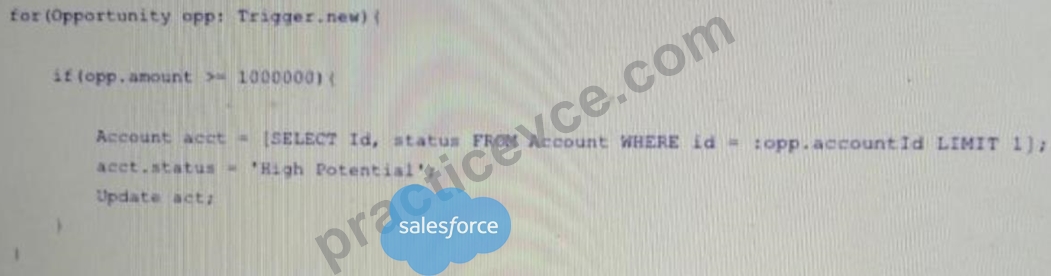
Which two changes should improve this code and make it more efficient? Choose 2 answers
- A. Move business logic inside the Opportunity trigger.
- B. Move the SOQL to fetch the account record outside of the for loop.
- C. Use Triginstead.old instead of Trigger.new.
- D. Move the DML outside of the for loop.
Answer: B,D
NEW QUESTION # 15
A developer needs test data for Apex test classes.
What can the developer use to provide test data to the test methods? (Choose two.)
- A. List<sObject> Is = Test.loadDat (Lead.sObjectType, $Resource + 'myTestLeads');
- B. Database.createTestRecords (10)
- C. List<sObject> Is = Test.loadData (Lead.sObjectType, 'myTestLeads');
- D. myDataFactory.createTestRecords (10)
Answer: C,D
Explanation:
Explanation/Reference:
NEW QUESTION # 16
In an organization that has multi-currency enabled, a developer is tasked with building a Lighting Component that displays the top ten Opportunities most recently access by the logged in user. The developer must ensure the Amount and LastModifiedDate field values are displayed according to the user's locale.
What is the most effective approach to ensure values displayed respect the users locale settings?
- A. Use the FORMAT() function in the SOQL query.
- B. Use the FOR VIEW clause in the SOQL Query.
- C. Use REGEX expressions to format the values retrieved via SOQL.
- D. Use a wrapper class to format the values retrieved via SOQL.
Answer: A
NEW QUESTION # 17
Which three approaches should a developer implement to obtain the best performance for data retrieval when building a Lightning web component? Choose 3 answers
- A. Use layoutTypes: 9'Full') to display a set of fields.
- B. Use getRecordUi to obtain metadata.
- C. Use lazy load for occasionally accessed data.
- D. Use {Cacheable=true} whenever possible
- E. Use the Lightning Data Service.
Answer: C,D,E
NEW QUESTION # 18
Which of the following exceptions cannot be caught and will force an error? (Choose three.)
- A. LimitException
- B. AssertException
- C. DMLException
- D. SObjectExceptions
- E. ListException
- F. License exceptions
Answer: A,B,F
Explanation:
Explanation
Explanation/Reference:
Explanation:
SObjectException occurs when accessing a field not queried, or you try to change a field during the wrong dml statement (i.e. an edit-only field being set on insert) Custom exceptions must extend the "Exception" class
NEW QUESTION # 19
An Apex test method is testing a Visualforce page's controller, which queries for all Opportunities in Salesforce with StageName = 'Closed'. There are 10,000 existing records that match the criteria. What is the best practice for accessing data in the test method?
- A. Create test data in the test method and use seeAllData=true.
- B. Create test data in the test method and use seeAllData=false.
- C. Query existing data in the test method and use seeAllData=true.
- D. Use @testVisible on the relevant property of the controller
Answer: B
NEW QUESTION # 20
A developer built an Aura component for guests to self-register upon arrival at a front desk kiosk. Now the developer needs to create a component for the utility tray to alert users whenever a guest arrives at the front desk.
What should be used?
- A. Component Event
- B. Application Event
- C. Changelog
- D. DML Operation
Answer: B
NEW QUESTION # 21
A developer has a test class that creates test data before making a mock callout but now receives a 'You have uncommitted work pending. Please commit or rollback before calling out' error.
Which step should be taken to resolve the error?
- A. Ensure the records are inserted before the Test.startTess() statement and the mock callout occurs after the Test. Startest().
- B. Ensure both the Insertion and mock callout occur after the I==L. stoptest_().
- C. Ensure the records are Inserted before the Tezt.startTest() statement and the mock callout occurs within a method annotated with @testSetup.
- D. Ensure both the insertion and mock callout occur after the Test.startTest().
Answer: A
Explanation:
When working with Apex tests that involve callouts, it's important to avoid the 'uncommitted work pending' error. This error typically occurs because DML operations (like inserts) are pending when a callout is attempted. Salesforce requires that all callouts are made before any DML operations in a transaction. To avoid this, the pattern is to insert the records before calling Test.startTest(), and then make the callout after this call. Test.startTest() marks the point where your actual test begins, and it resets the governor limits. By making the callout after this point, it ensures that the DML operations are committed and you are within a new execution context regarding governor limits.
References:
Testing HTTP Callouts by Implementing the HttpCalloutMock Interface
Understanding Execution Contexts
NEW QUESTION # 22
A developer is creating unit tests for code that makes SOAP web service callouts. The developer needs to insert some test data as a part of the unit tests setup.
What are three actions to enable this functionality? (Choose three.)
- A. Surround the callout with TeststartTest(), Test.stopTest()
- B. Surround the data insertion with Test.startTest(), Test.stopTest()
- C. Implement the WebServiceMock interface
- D. Implement the HttpCalloutMock interface
- E. Update code to call Test.setMock()
Answer: A,C,E
NEW QUESTION # 23
A company uses Dpportunities to track sales to their customers and their org has millions of Opportunities.
They want to begin to track revenue over time through a related Revenue object.
As part of their initial implementation, they want to perform a one-time seeding of their data by automatically creating and populating Revenue records for Opportunities, based on complex logic.
They estimate that roughly 100,000 Opportunities will have Revenue records created and populated.
What is the optimal way to automate this?
- A. Use system, enqueuJob (| to invoke a gueusable class.
- B. Use Database. executeBatch () to invoke a Queueable class.
- C. Use system, acheduladeb() to schedule a patakape.Scheduleable class.
- D. Use Database. =executeBatch() to invoke a Database. Batchable class.
Answer: D
Explanation:
For a one-time bulk operation on a large data set, using a Database.Batchable class is the best approach. This allows complex logic to be processed in manageable chunks and efficiently manages system resources.
References: Apex Developer Guide - Using Batch Apex
NEW QUESTION # 24
What is the correct syntax for calling a controller action from a Visualforce page and updating part of the page once the action is completed? (Choose two.)
<apex:commandFunction action="{!Save}" value="Save" rendered="thePageBlock"/>
- A. <apex:actionSupport action="{!Save} " event="onchange"
- B. <apex:commandButton action="{!Save}" value="Save" redraw="thePageBlock"/>
- C. rerender="thePageBlock"/>
- D. <apex:actionFunction action="{!Save}" name="Save" rerender="thePageBlock"/>
Answer: B,C
NEW QUESTION # 25
An Apex trigger creates a Contract record every time an Opportunity record is marked as Closed and Won.
This trigger is working great, except (due to a recent acquisition) Opportunity records need to be loaded into the Salesforce instance.
When a test batch of records are loaded, the Apex trigger creates Contract records. A developer is tasked with preventing Contract records from being created when mass Loading the Opportunities, but the daily users still need to have the Contract records created.
What is the most extendable way to update the Apex trigger to accomplish this?
- A. Use a list custom setting to disable the trigger for the user who loads the data.
- B. Use a hierarchy custom setting to skip executing the logic inside the trigger for the user who loads the data.
- C. Add a validation rule to the Contract to prevent Contract creation by the user who loads the data.
- D. Add the Profile ID of the user who loads the data to the trigger, so the trigger will not fire for this user.
Answer: B
NEW QUESTION # 26
As part of their quoting and ordering process, a company needs to send POFs to their document storage system's REST endpoint that supports OAuth 2.0. Each Salesforce user must be individually authenticated with the document storage system to send the PDF.
What is the optimal way for a developer to implement the authentication to the REST endpoint?
- A. Hierarchy Custom Setting with 2 password custom field
- B. Hierarchy Custom Setting with an OAuth token custom field
- C. Named Credential with an OAuth Authentication Provider
- D. Named Credential with Password Authentication
Answer: C
Explanation:
Named Credentials with OAuth handle secure API calls. Individual authentication for each user with OAuth
2.0 is managed through Named Credentials.References: Named Credentials as Callout Endpoints
NEW QUESTION # 27
Given the following information regarding Universal Containers (UC):
* UC represents their customers as Accounts in Salesforce.
* All customers have a unique Customer__Number_c that is unique across all of UC's systems.
* UC also has a custom Invoice c object, with a Lookup to Account, to represent invoices that are sent out from their external system.
UC wants to integrate invoice data back into Salesforce so Sales Reps can see when a customer pays their bills on time.
What is the optimal way to implement this?
- A. Query the Account Object upon each call to insert invoice data to fetch the Salesforce ID corresponding to the Customer Number on the invoice.
- B. Ensure Customer Number cis an External ID and that a custom field Invoice Number cis an External ID and Upsert invoice data nightly.
- C. Use Salesforce Connect and external data objects to seamlessly import the invoice data into Salesforce without custom code.
- D. Create a cross-reference table in the custom invoicing system with the Salesforce Account ID of each Customer and insert invoice data nightly,
Answer: D
NEW QUESTION # 28
When the code is executed, the callout is unsuccessful and the following error appears within the Developer Console:
System.CalloutException: Unauthorized endpoint
Which recommended approach should the developer implement
to resolve the callout exception?
- A. Use the SetHeader() method to specify Basic Authentication,
- B. Change the access modifier for ERPCatalog from public to global.
- C. Annotate the getkRFCatalogContents method with @Future (Callout-true),
- D. Create a remote site setting configuration that includes the endpoint.
Answer: D
Explanation:
The System.CalloutException with the message "Unauthorized endpoint" typically indicates that the endpoint to which the callout is being made has not been authorized in the Salesforce org's security settings. To resolve this, the developer must navigate to the Remote Site Settings in the Salesforce Setup and add the endpoint URL as a new remote site. This step is necessary to authorize the Salesforce org to send outbound callouts to that specific endpoint. Annotating with @Future(Callout=true) is necessary for making callouts from methods that perform DML operations, but it does not resolve endpoint authorization issues. Similarly, changing the access modifier or using SetHeader() for authentication would not address the unauthorized endpoint error.
References:
Remote Site Settings
Apex Developer Guide: Making Callouts Using Apex
NEW QUESTION # 29
......
PDII Dumps Full Questions - Exam Study Guide: https://killexams.practicevce.com/Salesforce/PDII-practice-exam-dumps.html