

2026 Easy Success CTTAM Civil-Engineering-Technology Exam in First Try
Best Civil-Engineering-Technology Exam Dumps for the Preparation of Latest Exam Questions
NEW QUESTION # 55
A surveyor is laying out the invert elevations of a storm sewer. Centre elevation is 10 m, storm pipe outside diameter is 1 m, and storm sewer pipe wall thickness is 0.05 m. What is the storm sewer invert elevation in the diagram below?
- A. 6.50 m
- B. 6.55 m
- C. 6.75 m
- D. 7.00 m
Answer: B
Explanation:
Theinvert elevationis the elevation of theinside bottomof the pipe (flow line). To compute invert from a reference elevation, the key geometry is theinside radius(half the inside diameter). Given an outside diameter (OD) of 1.00 m and wall thickness of 0.05 m, the inside diameter (ID) is: ID = 1.00 # 2(0.05) =0.90 m, so inside radius =0.45 m. The diagram indicates the pipe is located such that thepipe centreline elevationis at
7.00 m(derived from the shown vertical offset from the 10.00 m center elevation to the pipe center). The invert is therefore: 7.00 # 0.45 =6.55 m. Civil references define invert as the interior bottom of the conduit and use inside radius/diameter relationships when converting from centreline to invert. Hence, the correct invert elevation shown by the diagram and pipe geometry is6.55 m.
NEW QUESTION # 56
What test should be used to determine the compressive strength of concrete?
- A. Slump test
- B. Air test
- C. Cylinder test
- D. Sieve test
Answer: C
Explanation:
Concrete compressive strength is determined by loading astandard molded specimento failure in a compression testing machine and calculating strength from the peak load divided by the specimen's cross- sectional area. The common acceptance specimen for cast-in-place concrete is acylinder, produced and cured using standardized procedures to ensure that test results reliably represent the delivered concrete. Civil engineering materials references describe compressive strength testing as the principal measure used to verify compliance with specified strength (f'c), and that cylinder specimens are tested in compression to determine the maximum stress sustained.
A slump test measures workability/consistency, an air test measures entrained air content, and sieve testing measures aggregate gradation-none of these directly measure compressive strength. Therefore, the required test for compressive strength is thecylinder test (Option B).
NEW QUESTION # 57
Why is a builder's lien holdback important?
- A. To hold the contractor back from completing the job too quickly
- B. To protect the owner when a contractor goes bankrupt
- C. To protect the contractor from unscrupulous developers
- D. To protect the owner when a contractor does not pay the bills
Answer: D
Explanation:
A builder's lien holdback (often a statutory holdback such as 10% in many Canadian jurisdictions) is a payment amount withheld from progress payments to create afundthat can be used to satisfy lien claims if parties down the contracting chain (subcontractors, workers, suppliers) arenot paid. The intent is to protect the owner (and other payers) from having to "pay twice" for the same work: once to the contractor and again to unpaid lien claimants who can lien the project. Canadian construction lien frameworks describe holdbacks as a system designed to protect lien claimants while limiting the payer/owner's exposure by ensuring funds are available if unpaid claims arise. Practical explanations of holdbacks note that if a subcontractor or labourer is not paid, the holdback provides funds set aside to address those unpaid claims and associated lien risk. Therefore, the best answer is that the holdback protects theowner when the contractor does not pay the bills(i.e., unpaid subcontractors/suppliers can trigger liens).
NEW QUESTION # 58
The critical path refers to which of the following series of tasks in a schedule?
- A. Those that dictate the start date of a project
- B. Those that dictate the final cut and fills in a project
- C. Those that dictate the final cost of a project
- D. eect
Answer: D
Explanation:
The critical path is thelongest-duration paththrough a project network schedule and represents the sequence of activities withzero (or minimal) float. Because activities on this path have no schedule slack, any delay to a critical-path activity delays theproject completionunless mitigated (e.g., crashing, fast-tracking, resequencing). Standard project scheduling references define the critical path as the chain of tasks that determines theearliest possible finishdate; controlling and monitoring these tasks is essential for schedule management and forecasting. This is why contract administrators and project teams track critical activities and escalate risks affecting them-delivery delays, access constraints, approvals, and rework-because they directly move the completion milestone. Therefore, the critical path refers to tasks thatdictate the finish date of the project, which is optionA.
NEW QUESTION # 59
What should a contract administrator do when the contractor is falling behind schedule?
- A. Maintain daily records in preparation for seeking liquidated damages from the contractor.
- B. Keep accurate daily records of activities, progress, and site conditions, and hold regular meetings with the contractor.
- C. Find a new contractor who can meet the original completion date.
- D. Write a contemplated change order to hurry the contractor up.
Answer: B
Explanation:
When schedule performance deteriorates, the contract administrator's most effective and defensible actions are (1) to maintainaccurate contemporaneous recordsof progress, site conditions, and events affecting productivity, and (2) to actively manage communication throughregular progress meetingsfocused on recovery plans, constraints, and corrective actions. Good practice in civil engineering project administration emphasizes rigorous follow-up and maintaining accurate, up-to-date information for project control and claims management. Simply preparing for liquidated damages without engaging in management (C) is reactive, and replacing the contractor (A) is generally not an immediate contractual option. Issuing a change order to "hurry up" (B) is not a standard mechanism and may create cost/time disputes. Option D combines the two core controls-documentation and structured coordination-needed to evaluate entitlement, support mitigation, and keep stakeholders aligned while protecting the owner's position under the contract.
NEW QUESTION # 60
What would be the best step for an engineering team to propose to a client when reviewing a concept before a project is initiated?
- A. Life cycle cost analysis
- B. Detailed design
- C. Preliminary design
- D. Feasibility study
Answer: D
Explanation:
Before a project is initiated, the essential decision is whether the concept isviable-technically, economically, and in terms of risks, constraints, and stakeholder needs. Afeasibility studyis the recognized pre-initiation step that evaluates alternatives at a high level, confirms the problem/need, examines constraints, and establishes whether moving into design is justified. In civil engineering systems development, feasibility is treated as an early stage that precedes planning and detailed design, with early cost and uncertainty considerations explicitly tied to the feasibility stage. Life cycle cost analysis is valuable, but it is typically one component used within feasibility/planning decisions rather than the primary "best step" to propose before initiation. Preliminary and detailed design occur after feasibility confirms the concept should proceed.
Therefore, the best step to propose at concept review before initiation is afeasibility study.
NEW QUESTION # 61
Which of the following can a civil engineering technologist request from a concrete supplier to verify that concrete falls within municipal specifications?
- A. Batch location
- B. Geotechnical mix design
- C. Structural mix design
- D. Batch ticket from the plant
Answer: D
Explanation:
For ready-mixed concrete deliveries, compliance verification is commonly supported by thedelivery/batch ticket(often called the concrete delivery ticket). Industry guidance tied to ASTM C94 emphasizes that the ticket includes critical batch information (such as batch time and related data) used to confirm compliance with specified requirements and limits (including time limits for discharge and other production/traceability details). Because municipal specifications typically require confirmation of the delivered mix identification, quantities, admixtures, batching time, and other relevant production details, the batch/delivery ticket is the most direct document a technologist can request at the site to verify the delivered concrete aligns with the specified mix and placement requirements. A mix design submittal can show intended proportions but does not prove what was actually batched and delivered for that load; "batch location" alone is not sufficient;
"geotechnical mix design" is not applicable. Therefore, the correct item is thebatch ticket from the plant.
NEW QUESTION # 62
Which document must be submitted with a tender, if the project requires bonding?
- A. Building Permit
- B. Consent of Surety
- C. Certificate of Insurance
- D. Certificate of Recognition
Answer: B
Explanation:
When tender documents require bonding (e.g., bid bond with subsequent performance and labour/material payment bonds), owners often require evidence at tender time that the bidder's surety will provide the required bonds if the bidder is awarded the contract. AConsent of Surety(also referred to as an "agreement to bond" in many procurement contexts) is a document issued by the surety confirming its commitment to issue the required bonds for the project upon award, subject to stated conditions. This is used specifically during the tendering process to demonstrate bonding capacity/availability tied to that bid. The other documents listed (COR, insurance certificate, building permit) may be required at various stages, but they do not serve as the tender-stage confirmation of surety support for bonding. Therefore, the required tender submission when bonding is required isConsent of Surety.
NEW QUESTION # 63
What test should be used to determine the compressive strength of concrete?
- A. Slump test
- B. Air test
- C. Cylinder test
- D. Sieve test
Answer: C
Explanation:
Compressive strength is a hardened-concrete property verified by testing a standardized specimen under axial compression until failure. The standard field practice is to castconcrete cylindersfrom a representative sample, cure them under specified conditions, and test them in a compression machine at required ages (commonly 7 and 28 days) to confirm the concrete meets the specified strength. Civil engineering references describe that the compressive strength is computed from the maximum load at failure and the cylinder's cross- sectional area, and that cylinder testing is the accepted quality-control/acceptance method for structural concrete.
Slump testing only indicates fresh concrete consistency, air testing addresses durability-related air entrainment, and sieve testing applies to aggregates rather than hardened concrete strength. Thus, the correct test to determine compressive strength is thecylinder test (Option B).
NEW QUESTION # 64
The road cross sections shown have chainage (CH) 1+100 and 1+200. What is the volume of sub-grade material if an averaging method is applied?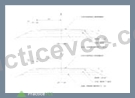
- A. 213 m³
- B. 131 m³
- C. 425 m³
- D. 850 m³
Answer: A
Explanation:
The averaging method for earthworks between two stations is theAverage End Areamethod:
whereandare the end areas at the two cross sections andis the station spacing. Here, CH 1+100 to 1+200 givesm. From the cross-section labels in the figure, the two sub-grade areas sum to4.26 m²(e.g., approximately 1.31 m² and 2.95 m²), so the average area ism². Multiply by length:m³. This is the standard approach used for roadway cut/fill and subgrade volume computations between surveyed sections.
NEW QUESTION # 65
What is the purpose of a spiral curve in highway design?
- A. To transition into a circular curve
- B. To slow traffic when the superelevation of the lane is greater than 5%
- C. To slow traffic when the minimum sight distance cannot be achieved
- D. To transition onto a vertical curve
Answer: A
Explanation:
Aspiral (transition) curveis used in horizontal alignment to provide a gradual change in curvature from a tangent (infinite radius) to a circular curve (constant radius). AASHTO explains that spiral transition curves simulate the natural turning path of a vehicle and allow lateral acceleration (and side friction demand) to increase/decrease gradually as drivers enter/exit the circular curve, improving comfort and reducing encroachment. AASHTO also notes that the transition curve length provides a suitable location to develop superelevation runoffsmoothly from normal crown to full superelevation. These functions are specifically about transitioning into (and out of) the circular curve, not slowing traffic or transitioning vertical alignment.
Therefore, the purpose of a spiral curve isto transition into a circular curvewhile providing a smooth geometric and superelevation transition for drivers.
NEW QUESTION # 66
What subsurface sampling would be most likely conducted during a preliminary site investigation for a proposed building?
- A. Atterberg limits and detailed grading plans
- B. Soil samples and borehole logs
- C. Marshall tests and proposed driveway locations
- D. Proctor densities and final building elevations
Answer: B
Explanation:
A preliminary site investigation for a building focuses on defining subsurface stratigraphy and basic engineering characteristics byexploring the ground and documenting soil/rock conditions versus depth.
Standard practice usesborings (drilling/boring)to obtain samples and observations, which are then recorded asborehole logsdescribing layers, groundwater, and recovered materials. The sampling provides representative soils for index testing and classification, but the fundamental "subsurface sampling" deliverables at the preliminary stage are thesoil samples retrievedand theborehole logsthat document what was encountered. Broader design deliverables like grading plans, final elevations, or pavement Marshall testing are not part of preliminary geotechnical sampling for a building footprint. Civil engineering references describe subsurface exploration as involving drilling/boring and retrieving soil/rock samples at various depths, with the engineer examining cuttings and recovered samples to characterize the profile-information typically captured in borehole logs.
NEW QUESTION # 67
A civil engineering technologist is performing a concrete test on a site. What minimum number of cylinders should the technologist make?
- A. One
- B. Three
- C. Five
- D. Four
Answer: D
Explanation:
Concrete compressive strength is verified using standardized specimens that represent the delivered concrete.
A typical field/lab testing program preparesa set of cylindersso strength can be checked at standard ages and so at least one specimen remains available if a test is invalid or confirmation is required. InExperiment Design for Civil Engineering, the compressive strength procedure explicitly states thatsets of four cylindersshould be prepared and thenone cylinder from each setis tested at7, 14, 21, and 28 days. This "four-cylinder set" directly supports the minimum needed to obtain a time-history of strength development through the common curing ages used in practice and referenced by ASTM C39 age tolerances. While many projects may require additional cylinders (for 7-day early breaks, hold cylinders, or additional acceptance tests), the question asks theminimumnumber, and the documented testing set described isfour.
NEW QUESTION # 68
Which joints in concrete slab construction determine the location of cracks?
- A. Construction
- B. Isolation
- C. Control
- D. Expansion
Answer: C
Explanation:
Concrete slabs shrink as they cure and experience temperature/moisture changes. Because the slab is restrained by subbase friction and adjacent elements, tensile stresses develop and cracking is likely unless the slab is intentionally "weakened" at planned locations.Control joints(also called contraction joints) are formed or saw-cut to create a deliberate plane of weakness so that shrinkage cracking occurswhere intended, producing straighter, serviceable cracks that are easier to seal and maintain. Technical references describe contraction/control joints as placed at regular intervals specifically tocontrol random crackingby encouraging the crack to form along the joint line, relieving tensile stresses in the slab. Expansion joints address thermal expansion, isolation joints separate the slab from fixed elements, and construction joints occur where placements stop and start; none of those are primarily intended tocontrol crack locationthe way control joints are. Therefore, the joint type that determines where cracks occur is thecontrol joint.
NEW QUESTION # 69
A cologist is required to inspect the installation of a sanitary service pipe to confirm the slope. The technologist measures an elevation of 705.667 at the end of the service and 705.202 at the main. The horizontal measurement from the main to the end of the service is 22.10 m. What is the slope of the pipe?
- A. 1.5%
- B. 2.0%
- C. 2.1%
- D. 2.5%
Answer: C
Explanation:
Pipe slope is computed asrise (or fall) divided by run, expressed as a percent:
This matches standard civil engineering definitions of grade/slope as elevation change over horizontal distance.
Here, the elevation drop from the service end to the ma5.202 =0.465 m.
Horizontal distance (run) =22.10 m.
Slope = 0.465 / 22.10 = 0.02104 =2.104%, which rounds to2.1%.
This calculation reflects standard practice used in roadway and pipeline work for checking grades, confirming that installed utilities meet design slopes for gravity flow. The answer choice that matches the computed slope is2.1% (Option C).
NEW QUESTION # 70
Whatto determine the compressive strength of concrete?
- A. Slump test
- B. Air test
- C. Cylinder test
- D. Sieve test
Answer: C
Explanation:
Concrete compressive strength is determined by loading astandard specimen(commonly a cylinder) in axial compression until failure and calculating strength as themaximum load divided by the specimen's cross- sectional area. This is the core acceptance/quality-control measure used to verify that concrete meets the specified design strength in contract documents. Civil engineering materials references describe that compressive strength (f'c) is measured from the maximum load at failure and that standardized procedures (e.
g., ASTM C31 for making/curing and ASTM C39 for testing) are used to ensure consistency and reduce testing error.
Laboratory/field experiment procedures similarly definngth test as a compression machine test on a concrete cylinder, with load increased to failure and strength computed from the peak load and cylinder area.
Slump testing measures workability/consistency, air tesed air, and sieve testing relates to aggregate gradation-none provide compressive strength. Hence, the correct test is thecylinder test.
NEW QUESTION # 71
A geotechnical report indicates the presence of a peat layer in several boreholes. The peat layer ranges in thickness from 450 mm to 1200 mm and is found at a depth of 1.5 m below the existing grade. How should this be addressed in the project specifications that are being prepared?
- A. Propose a method of stabilizing the peat layer in the specifications
- B. Include a clause stating that the peat should be removed from the area
- C. Advise the bidders that the peat layer is present
- D. Determine the bearing strength of the peat material and include this information in the specifications
Answer: B
Explanation:
Peat is a highly organic soil withvery high compressibility, low shear strength, and problematic long-term settlement behavior. If peat is present within the stress influence zone of foundations or slabs (here, relatively shallow at ~1.5 m depth), typical construction practice is to treat it asunsuitable materialunless a designed ground-improvement solution is explicitly adopted. When the geotechnical investigation identifies such material in advance, the project specifications should convert that known condition into aclear scope requirementso pricing and execution are defined-commonly by requiringover-excavation/removal and replacement with suitable compacted fillin affected areas, subject to engineer direction and limits. USACE guidance for earthworks/foundations explicitly states thatsoft or organic spots in the foundation should be removed and replaced with compacted materialas part of foundation preparation.
Therefore, the most appropriate way to address the identified peat in the specifications is toinclude a clause requiring peat removal(and replacement per spec), which isOption C.
NEW QUESTION # 72
Prior to entering an active construction site, what must all visitors do?
- A. Put on the appropriate Personal Protective Equipment (PPE).
- B. Call supervisor notifying of site visit.
- C. Show identification credentials.
- D. Check in at the site office for permission.
Answer: A
Explanation:
Active construction sites present immediate hazards (struck-by, slips/trips, falling objects, dust/noise, and equipment interaction). Safety standards require that anyone entering hazard areas wear therequired PPEfor that site (hard hat, safety footwear, high-visibility apparel, eye protection, etc.) as dictated by the site's hazard assessment and rules. EM 385-1-1 requires PPE use appropriate to exposures and includes provisions for visitors/inspectors/survey crews who may be exposed to construction hazards and traffic/equipment. While checking in or notifying supervision may be a site rule, the universally mandatory precondition for entry into active work zones is wearingappropriate PPE, because it is the primary control that reduces immediate injury risk upon entering the site environment. Therefore, the correct choice isA.
NEW QUESTION # 73
......
Civil-Engineering-Technology Study Material, Preparation Guide and PDF Download: https://killexams.practicevce.com/CTTAM/Civil-Engineering-Technology-practice-exam-dumps.html