

[UPDATED 2023] Free Nokia 4A0-116 Exam Questions Self-Assess Preparation
4A0-116 Free Sample Questions to Practice One Year Update
Segment routing is a new approach to network routing that offers simplified network management and improved network scalability. It allows network administrators to specify a path that network traffic should take through the network by labeling each packet with a unique identifier. This technology is becoming increasingly popular in the networking industry, and the Nokia 4A0-116 certification exam is designed to equip professionals with the necessary skills and knowledge to implement and manage segment routing networks.
Nokia 4A0-116 certification exam is recognized globally and is highly regarded by employers in the networking industry. It is an industry-standard certification that demonstrates a candidate's mastery of segment routing technology and their ability to design and implement complex network solutions. Nokia Segment Routing Exam certification process involves taking a rigorous exam that tests candidates' knowledge and skills in Nokia Segment Routing technology. By passing the Nokia 4A0-116 exam, candidates can demonstrate to potential employers that they have the skills and expertise to succeed in today's fast-paced networking industry.
In 4A0-116 exam, candidates will be tested on their understanding of the key concepts, features, and functions of Nokia's Segment Routing technology. They will be required to demonstrate their ability to configure and implement Segment Routing in a variety of network scenarios, including virtual private networks (VPNs), quality of service (QoS) policies, and network slicing. Additionally, candidates will be evaluated on their ability to troubleshoot issues related to Segment Routing and provide effective solutions.
NEW QUESTION # 12
Which of the following statements about Multi-Protocol Label Switching networks is FALSE?
- A. An LSP is a bi-directional tunnel that uses MPLS labels to forward data.
- B. MPLS uses a signaling protocol to exchange labels between routers.
- C. The data is transparently carried from end to end.
- D. An LSR forwards data based on the MPLS labels.
Answer: C
Explanation:
The data is transparently carried from end to end: This statement is not true, MPLS does not provide data transparency, which means that the data is not carried unmodified from end to end. MPLS uses labels to forward data, so the original IP packets are encapsulated in new MPLS packets, and the original IP headers are not visible at the egress LSR.
NEW QUESTION # 13
Which of the following statements about segment routing fast re-route is FALSE?
- A. The parameter "max-sr-frr-labels" limits the number of labels that R-LFA can add to the data packet encapsulation.
- B. Fast re-route is a temporary fix that becomes active for a short period of time after a local network failure.
- C. Fast re-route typically protects the active segment of a tunnel, but under certain conditions it can protect an end-to-end multi-segment tunnel instead.
- D. On a Nokia 7750 SR, R-LFA and TI-LFA can be enabled independently of each other.
Answer: D
Explanation:
On a Nokia 7750 SR, R-LFA and TI-LFA cannot be enabled independently; they must be enabled together. The parameter "max-sr-frr-labels" limits the number of labels that R-LFA can add to the data packet encapsulation.
NEW QUESTION # 14
Based upon the exhibit, which of the following statements regarding the configuration is FALSE?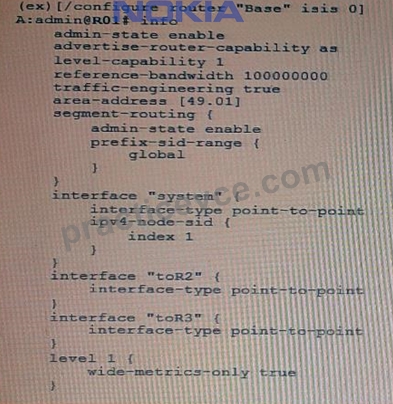
- A. Traffic engineering information will only be advertised for the interfaces that have both MPLS and RSVP enabled.
- B. The Node-SID assigned to this router is the second label in the defined range.
- C. Adjacency-SID labels will not be advertised as they have not been defined under the physical interfaces.
- D. Traffic engineering has been enabled on this router.
Answer: A
NEW QUESTION # 15
Which of the following statements about Segment Routing tunnels is FALSE?
- A. A Segment Routing tunnel can be defined by multiple Node-SIDs.
- B. For a Segment Routing tunnel, an intermediate router will always forward the packet based on the best IGP path.
- C. A Segment Routing tunnel defined by a Node-SID uses the shortest IGP Path.
- D. A Segment Routing tunnel can be defined by a combination of Node-SIDs and Adjacency-SIDs.
Answer: B
Explanation:
an intermediate router in a Segment Routing tunnel may forward packets based on the specific SIDs defined in the Segment Routing tunnel and not always the best IGP path.
NEW QUESTION # 16
The exhibit presents packets being transmitted inside an LSP's multi-segment primary path going from router R1 to router R8. The LSP also has a standby secondary path, and Seamless-BFD has been enabled on the primary path. The link between routers R1 and R2 fails, and fast re-route (FRR) is triggered. As a result, router R1 forwards the packets to router R3 and adds the proper FRR encapsulation to reach which router?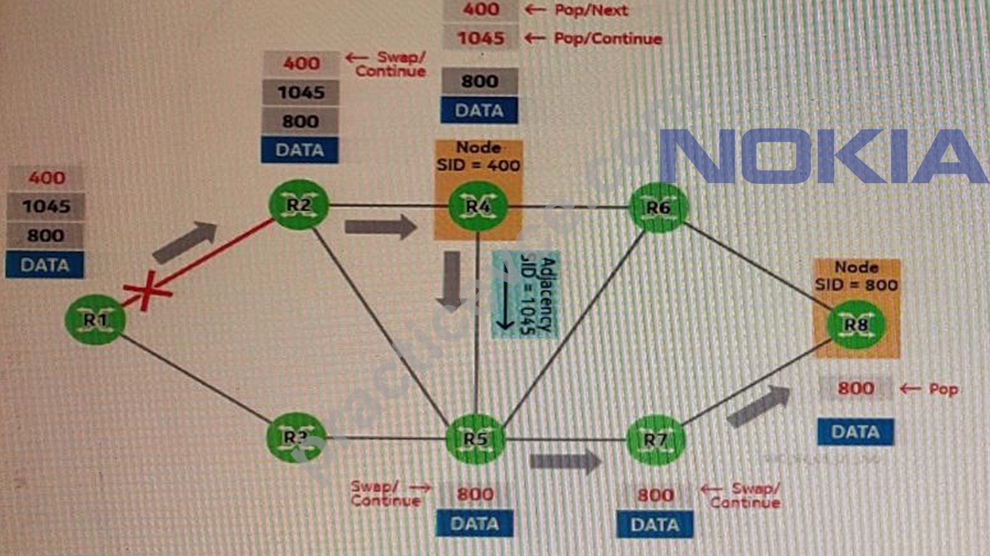
- A. To reach router R8, which is the tail-end of the LSP.
- B. To reach router R2, which is the LSP's intended next-hop.
- C. To reach router R4, which is the tail-end of the active segment.
- D. To reach router R5, which is the shortest way to go back to the original path.
Answer: D
NEW QUESTION # 17
Which of the following is NOT a valid option to steer traffic into a flex-algo segment-routing tunnel?
- A. Configuring and applying a VSI import policy to an EVPN service and enabling the sr-is-is or sr-ospf tunnel type for the service, depending on the underlying routing protocol.
- B. Specifying the flex-algo instance ID as an additional TE constraint for an SR-TE LSP and enabling the sr-te tunnel type for a VPN service.
- C. Configuring and applying a VRF import policy to a VPRN service and enabling the sr-is-is or sr-ospf tunnel type for the service, depending on the underlying routing protocol.
- D. Using a flex-algo Node-SID as an explicit hop in the path definition of an SR-TE LSP and enabling the sr-te tunnel type for a VPN service.
Answer: A
Explanation:
Applying a VSI import policy to an EVPN service and enabling the sr-is-is or sr-ospf tunnel type for the service is not a valid option for steering traffic into a flex-algo segment-routing tunnel, VSI is not related to flex-algo SR.
NEW QUESTION # 18
In the context of a network that includes a Path Computation Element (PCE), what is a PCC-initiated LSP?
- A. An LSP for which the initial path is calculated by the head-end router.
- B. An LSP for which the path repairs and re-optimizations must be triggered by the head-end router.
- C. An LSP whose existence and state are reported to the PCE.
- D. An LSP that needs to be explicitly configured on the head-end router.
Answer: C
Explanation:
A PCC-initiated LSP is an LSP that is established and controlled by the PCC (Path Computation Client) which is typically a head-end router. The PCC sends LSP setup and teardown requests to the PCE and also reports the existence and state of the LSPs to the PCE. The PCE then uses this information to perform path computation and to monitor the state of the LSPs.
NEW QUESTION # 19
Which of the following is NOT one of the main goals of traffic engineering?
- A. Utilizing redundant links.
- B. Defining traffic paths based on various constraints.
- C. Using the shortest possible path through the network to the destination.
- D. Avoiding potential congestion points in the network.
Answer: C
NEW QUESTION # 20
Examine the exhibit. Based upon the configuration, which routers will the LSP go through?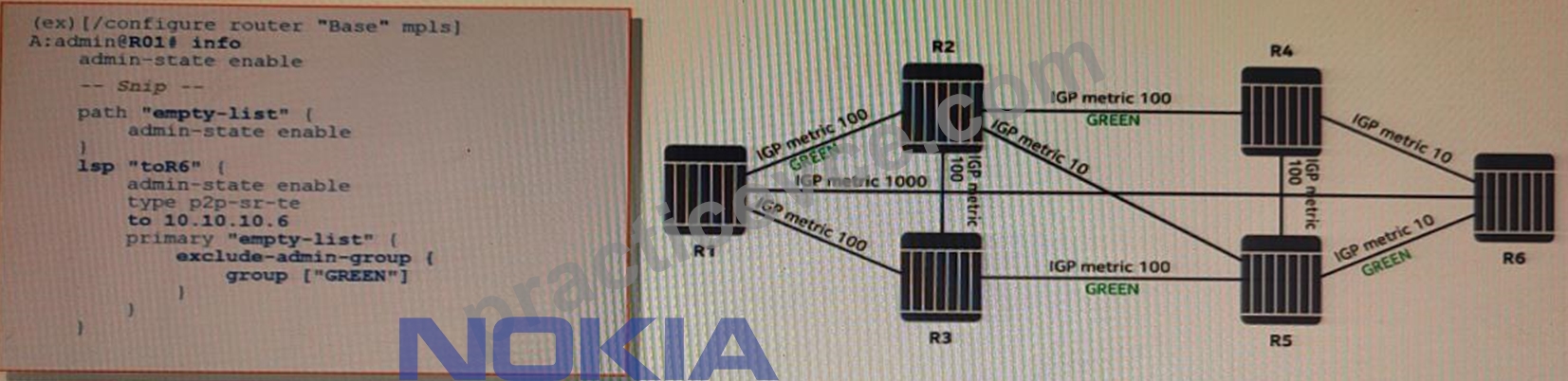
- A. R1, R2, R5 and R6
- B. R1, R3, R2, R5, R4 and R6
- C. R1, R3, R4 and R6
- D. R1, R2, R4 and R6
Answer: C
NEW QUESTION # 21
OSPF is being used for segment routing with traffic-engineering (SR-TE). The traffic-engineering option has been set to "sr-te false". Which of the following statements is TRUE?
- A. The TE information will only be advertised using application-specific sub-TLVs.
- B. The TE information will be advertised for all the OSPF links that have MPLS enabled.
- C. The TE information will only be advertised for the OSPF links that have both MPLS and RSVP enabled.
- D. The TE information will only be advertised using extended-link opaque LSAs.
Answer: D
Explanation:
When using Segment Routing with Traffic Engineering (SR-TE) in OSPF, the TE information is advertised using extended-link opaque LSAs. The option "sr-te false" indicates that OSPF will not advertise the TE information in the OSPF database, thus the routers will not be aware of the TE information.
NEW QUESTION # 22
The exhibit shows the fast re-route configuration on router R1, in which both R-LFA and TI-LFA have been enabled. Assume that there are multiple potential backup paths for a given prefix. Which of the following options will router R1 use?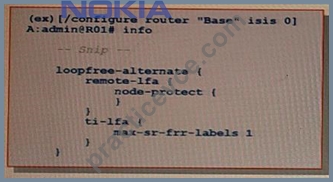
- A. A D-LFA path that would not coincide with the path after IGP re-convergence.
- B. A D-LFA path that would coincide with the path after IGP re-convergence.
- C. An R-LFA path that would not coincide with the path after IGP re-convergence.
- D. A standard LFA path that would not coincide with the path after IGP re-convergence.
Answer: B
Explanation:
The exhibit shows that both R-LFA and TI-LFA have been enabled on router R1. R-LFA (Remote Loop-Free Alternate) is a method that is used to protect the active segment of a tunnel, and it allows the router to find a backup path that coincides with the path that will become active after IGP reconvergence. TI-LFA (Topology Independent LFA) is a method that is used to protect an end-to-end multi-segment tunnel, it allows the router to find a backup path that does not rely on the IGP topology, but on the segment routing topology.
With R-LFA and TI-LFA enabled, router R1 will use a D-LFA (Dual-Loop-Free Alternate) path, which is a combination of both R-LFA and TI-LFA, this path will coincide with the path after IGP re-convergence.
A standard LFA, R-LFA, and D-LFA which do not coincide with the path after IGP re-convergence are not the options.
NEW QUESTION # 23
Which of the following steps is NOT required when configuring IS-IS to support Segment Routing?
- A. MPLS label range reserved for Segment Routing.
- B. The Segment Routing Global Block range.
- C. The flooding scope of Segment Routing information.
- D. Enable interfaces used for Segment Routing under
Answer: D
Explanation:
Enable interfaces used for Segment Routing under: This step is not required, enabling interfaces used for Segment Routing is not necessary as the IS-IS protocol already takes care of the flooding of the routing information.
NEW QUESTION # 24
Which of the following is not required to be advertised by a router participating in Segment Routing?
- A. SRGB when SRv6 is configured
- B. Adjacency-SIDs
- C. Support for SR-MPLS for IPv4 or IPv6, or SRv6
- D. Local Node-SID
Answer: A
Explanation:
SRGB when SRv6 is configured: This is not required to be advertised, SRGB(Segment Routing Global Block) is only used for SR-MPLS and is not needed when SRv6 is configured. Instead, SRv6 uses the IANA-assigned IPv6 address space.
NEW QUESTION # 25
Which of the following statements about the Path Computation Element (PCE) is FALSE?
- A. A stateful PCE proactively monitors all the existing LSPs and triggers the necessary repairs and re-optimizations.
- B. A stateful PCE can allow LSPs to reserve bandwidth.
- C. A stateless PCE can calculate cross-area traffic-engineering-constrained LSP paths.
- D. The PCE can obtain topology and traffic-engineering information from the network using either a link-state IGP or BGP-LS.
Answer: B
Explanation:
Stateful PCE can monitor the existing LSPs and trigger necessary repairs and re-optimizations, but it does not have the capability to reserve bandwidth.
NEW QUESTION # 26
Which of the following statements about a Segment Routing SID is FALSE?
- A. A Prefix-SID can be configured directly as a label value or indirectly as an index.
- B. A Node-SID is usually associated with a router's system interface.
- C. Adjacency-SID values are taken from the SRGB configured for the routing protocol.
- D. An Adjacency-SID does not have to be configured.
Answer: D
Explanation:
An Adjacency-SID does not have to be configured: this statement is not true, An Adjacency-SID is associated with a neighbor router, it is used to identify an adjacency between two routers. An Adjacency-SID must be configured to identify the adjacency.
NEW QUESTION # 27
Which of the following statements about Segment Routing is FALSE?
- A. No path signaling is required to establish an SR tunnel.
- B. For TE-constrained tunnels, each data packet typically carries a single MPLS label to specify the tunnel path.
- C. Intermediate routers do not maintain any tunnel informal
- D. A link-state IGP is required to distribute SID information.
Answer: C
Explanation:
Intermediate routers do not maintain any tunnel informal: this statement is false, Intermediate routers do maintain tunnel information, such as the Forwarding Information Base (FIB) to forward the packets according to the path specified in the packets.
NEW QUESTION # 28
......
Real exam questions are provided for Nokia Service Routing Architect tests, which can make sure you 100% pass: https://killexams.practicevce.com/Nokia/4A0-116-practice-exam-dumps.html